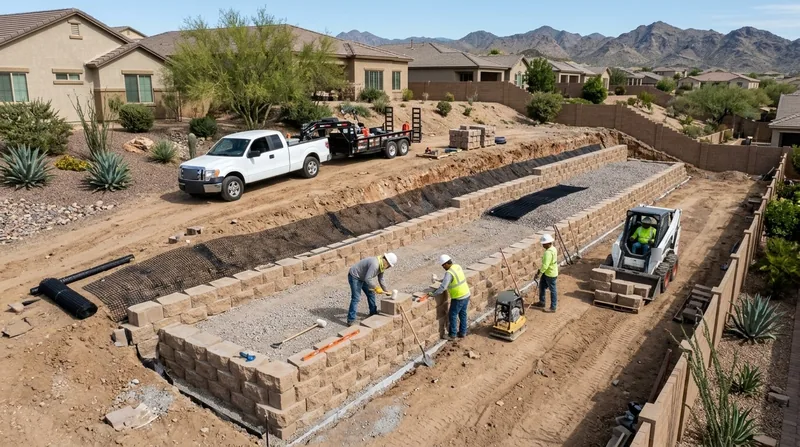




Block and segmental retaining walls in Phoenix are engineered systems built from interlocking modular blocks, reinforced with geogrid, and stacked without mortar to create durable terraces, planters, and slope supports across the valley. From the 1950s ranch homes of Arcadia with their flood-irrigated lots to the newer foothills properties climbing Ahwatukee and Paradise Valley, Phoenix homeowners face unique wall challenges: caliche hardpan that traps water after monsoon storms, pockets of expansive clay that shift foundations, and the relentless desert sun that can crack older concrete and stucco-faced CMU walls. Segmental block systems (Allan Block, Versa-Lok, Keystone) offer a modern, flexible alternative that handles these conditions better than poured concrete or timber, while maintaining the clean lines and curved aesthetics that desert landscaping demands. Unlike rigid monolithic walls, segmental blocks can settle slightly and shift with ground movement without failing, making them ideal for terraced desert gardens, pool-side features, and driveway retaining applications. We design and install these walls to local code, with proper drainage and geogrid reinforcement, so they stand through flash flooding, caliche breakthrough, and the thermal cycling of 120-degree summers and cool desert nights.
Why Block and Segmental Retaining Walls Matter in Phoenix's Desert Landscape
Phoenix's terrain is deceptive. Most lots appear flat across the valley floor, but many sit on sloping washes, terraced foothills, or cut slopes where water and gravity demand serious wall engineering. The local building stock, from 1920s Spanish Revival homes in Encanto to 1970s stucco tracts across Maryvale and newer desert ridge developments, often features poorly drained cuts or fill slopes that shift under our intense monsoon season. Segmental retaining walls handle these conditions because they flex slightly, drain freely through the block joints, and are easy to repair or extend if ground settlement occurs. They also accept curved layouts and tiered designs that work well with desert xeriscaping and pool surrounds.
- Segmental blocks drain water naturally through mortarless joints, preventing the caliche-trapped saturation that collapses older concrete walls after monsoon flooding.
- Geogrid reinforcement anchors the wall into stable soil, resisting the expansive clay pockets common in Phoenix foothill and wash-side parcels.
- Modular design allows us to build curved planters, tiered terraces, and pool-side features without complex formwork or pouring delays.
- Blocks can be replaced individually if damage occurs, avoiding the total wall reconstruction that poured concrete often requires.
- Engineered systems meet Phoenix and local jurisdiction setback and height codes, with drawings available for permitting on walls above 4 feet or supporting surcharges like driveways.
Because segmental walls are mortarless and modular, they are less likely to suffer the catastrophic cracking and spalling that plague older CMU and poured concrete walls under Phoenix's temperature swings and moisture extremes.
Key info: Phoenix's caliche hardpan, a calcium carbonate layer that forms 2 to 6 feet below the surface, traps water during monsoon season and causes hydrostatic pressure that pushes older concrete and CMU walls outward. Segmental block systems with proper base drainage and geogrid prevent this failure mode entirely. For more on drainage solutions, see our retaining wall drainage service.
For permitting guidance specific to your jurisdiction, check with your local building department; many Phoenix-area municipalities (Phoenix, Scottsdale, Tempe, Mesa, Chandler, Gilbert, Peoria, Surprise, and others) require engineered drawings and a permit for walls above 4 feet or when a wall supports a structure or driveway surcharge. Requirements vary, so verification with your city or county is essential before construction begins.
How We Design and Build Block and Segmental Retaining Walls in Phoenix
Our process starts with a site visit to understand soil type, drainage patterns, setback and property-line constraints, and any surcharge (driveway, pool, structure) that the wall must support. We assess the base soil, check for caliche or clay pockets, and design the wall height, block type, and geogrid reinforcement accordingly. Once the design is locked, we prepare the base with proper compaction and drainage rock, lay the first course level, and stack subsequent courses with geogrid every 1 to 2 feet of height, backfilling with engineered drain rock to prevent saturation. The result is a wall that settles evenly, sheds water, and resists the ground movement that causes leaning and collapse in older Phoenix walls.
- We evaluate soil conditions on-site and recommend block type and reinforcement depth based on local caliche, clay, and drainage characteristics.
- We excavate and compact the base course to prevent settling and ensure the wall stays level and plumb over time.
- We install geogrid reinforcement at proper intervals and backfill with drain rock to direct water away from the wall and prevent hydrostatic buildup.
- We set each block course level and aligned, checking plumb and verifying that any surcharge (driveway, landscape) is properly distributed across the wall.
- We cap the wall with finished blocks and grade the backside to slope away, ensuring long-term drainage and stability.
From initial estimate to final cleanup, we handle permitting coordination, material delivery, and site restoration so you can focus on your landscape or project timeline.
Example: A homeowner in Ahwatukee needed a 5-foot Versa-Lok wall to terrace a sloping lot for a pool and patio. We identified caliche at 4 feet, installed 3 feet of geogrid reinforcement, and used a 12-inch drain rock backfill. The wall has remained level and dry through two monsoon seasons. See our retaining wall installation service for more examples.
Block and Segmental Retaining Wall Systems: Comparison and Applications
| System | Description | Best For |
|---|---|---|
| Allan Block | Modular concrete block with pin-lock system, mortarless joints, 6 to 12 inches high, available in multiple colors and finishes. | Residential terraces, planter walls, curved garden features, pools, and driveway retaining in Phoenix valley and foothills. |
| Versa-Lok | Engineered block with integrated geogrid pockets, mortarless, 8 to 12 inches high, designed for reinforced walls up to 20+ feet. | Tall terraces, hillside retaining, slope stabilization, and applications where heavy surcharge (structure, fill) is present. |
| Keystone | Large-format interlocking block, mortarless, 12 inches high, with geogrid capability, modern aesthetic and fast installation. | Commercial and residential applications, modern landscape design, fast-track projects, and walls where visual impact matters. |
| Geogrid Reinforcement | Polymer or fiberglass grid laid horizontally between block courses to anchor the wall into stable soil and resist tensile forces. | All walls above 4 feet, any wall supporting surcharge, and all walls in Phoenix where caliche or clay pockets are present. |
Block and Segmental Retaining Walls Cost in Phoenix: What to Expect
The cost of a block and segmental retaining wall in Phoenix starts at approximately $25 to $40 per square foot of wall face, depending on block type, wall height, soil conditions, and site access. A 50-foot-long wall that is 4 feet tall runs about 200 square feet of face, putting the base cost in the $5,000 to $8,000 range before permits, drainage upgrades, or surcharge engineering. Taller walls (6 to 8 feet), walls in tight foothills terrain, or walls requiring extensive geogrid and drain rock backfill can reach $50 to $65 per square foot. Factors that push costs higher include caliche removal, poor soil requiring deeper reinforcement, limited equipment access, and engineered drawings for permitting.
We recommend getting 2 to 3 estimates from licensed contractors so you can compare design approach, material choices, and warranty. A low bid that skips drainage or geogrid may save money upfront but will fail under Phoenix's monsoon and expansive soil conditions. Our estimates include a site visit, soil assessment, material and labor, permits, and cleanup, with no hidden charges. Visit our pricing page for a detailed breakdown and to request a free estimate.
What to Look for When Hiring a Block and Segmental Retaining Wall Contractor Near Phoenix
Choosing the right contractor near Phoenix means verifying licensing, insurance, and local experience with segmental systems and desert soil conditions. Many homeowners assume all retaining wall contractors are equal, but the difference between a crew that understands caliche, expansive clay, and monsoon drainage and one that does not can mean the difference between a wall that lasts 30 years and one that fails in 5. Ask for proof of Arizona contractor license, general liability and workers compensation insurance, and references from recent jobs in your area (Phoenix, Scottsdale, Tempe, Mesa, Chandler, Gilbert, Peoria, Surprise, or your specific neighborhood). Confirm that the contractor will pull permits and obtain engineered drawings if your wall is above 4 feet or supports a surcharge. Also check whether your HOA has design or material approval requirements before work begins.
- Verify that the contractor holds an active Arizona Contractor License and carries current general liability and workers compensation insurance certificates.
- Request 3 to 5 references from similar projects completed in the past 2 to 3 years, and contact them to ask about drainage performance and long-term stability.
- Confirm that the contractor will handle permitting and provide engineered drawings if your local jurisdiction requires them for walls above 4 feet or supporting surcharge.
- Ask about the contractor's soil assessment process and how they account for caliche, clay, and monsoon water management in the design.
- Get a written estimate that itemizes materials, labor, permits, and cleanup, and clarifies what happens if unexpected soil conditions are found during excavation.
Once you have selected a contractor, contact us for a free, no-obligation estimate and a detailed explanation of our approach to your specific site and soil conditions.
Block & Segmental Retaining Walls in Phoenix: Pricing Guide
| Service | Price | Details |
|---|---|---|
| Segmental block walls, standard height (3 to 5 feet) | Starting at $25/sq ft | Includes block, geogrid reinforcement, base prep, drainage rock backfill, and labor to install in typical Phoenix soil |
| Tall or reinforced walls (6 to 8+ feet) or caliche removal | Starting at $40/sq ft | Deeper geogrid, extended base preparation, caliche breakthrough, and engineered drawings add material and labor cost |
| Complex site: tight access, hillside terrain, or multiple tiers | On estimate | Equipment limitations, multiple wall sections, or challenging drainage require site-specific labor and material planning |
| Permits and engineered drawings | Included | We coordinate with your local building department and prepare drawings if your wall height or surcharge requires approval |
| Free estimate | No charge | Response within 24 hours at (480) 494-4792; includes site visit, soil assessment, and written proposal with no obligation |
Indicative pricing, the exact cost depends on square footage, finish, and site access. Free personalized estimate within 24h at (480) 494-4792.


