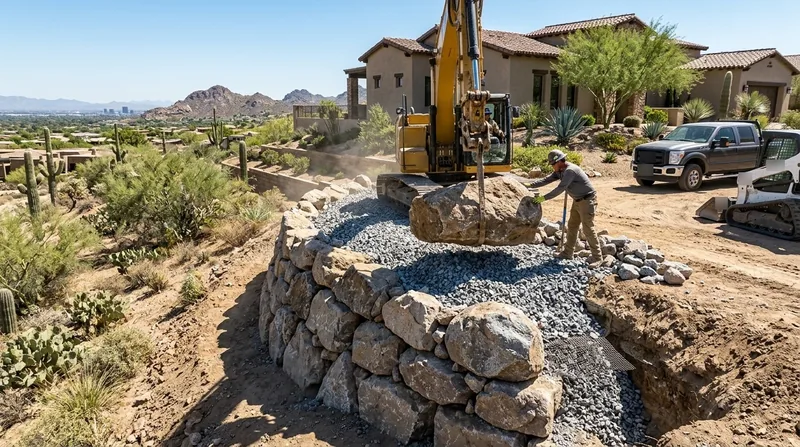




Boulder and natural stone retaining walls in Phoenix blend seamlessly into desert hillsides and foothill landscapes, offering durability and aesthetic appeal that concrete or block simply cannot match. Phoenix homeowners on sloped lots, in foothills neighborhoods like Ahwatukee and Moon Valley, and along wash-side properties rely on native granite boulder walls to hold cut slopes, stabilize driveways, and create terraced desert gardens. The Phoenix Valley's flat terrain is ringed by rocky mountain preserves, and natural stone walls echo that native character while performing the critical job of erosion control and slope stabilization. Unlike timber walls that fail to termites or concrete walls that crack under Phoenix's intense sun and monsoon runoff, properly installed boulder walls last decades with minimal maintenance. We machine-place native granite construction with engineered base preparation and drainage to handle caliche hardpan, expansive clay pockets, and the flash flooding that roars through washes after summer storms.
Why Boulder and Natural Stone Walls Matter in Desert Phoenix Terrain
Phoenix's unique geography, from Spanish Revival homes in Encanto-Palmcroft to 1950s slump-block ranches on flood-irrigated Arcadia lots and newer hillside homes climbing the foothills, creates diverse retaining wall demands. Many properties sit on slopes where water management is critical, especially in neighborhoods that back up to washes or mountain preserves. The desert climate, intense summer heat, and seasonal monsoon flooding place enormous stress on walls built with inferior materials or inadequate drainage. Natural stone walls handle these conditions far better than aging timber or cracking concrete, and they blend into Phoenix's native landscape rather than standing out as industrial structures.
- Native granite boulders withstand Phoenix's white-hot summer sun and golden desert evenings without fading, cracking, or warping like timber or concrete.
- Proper drainage systems prevent water from pooling behind the wall, a critical failure point in Phoenix where caliche hardpan traps moisture and expands clay soil.
- Machine-placed construction ensures each stone is set firmly, resisting the lateral pressure from monsoon cloudbursts and flash flooding through adjacent washes.
- Boulder walls create natural-looking terraces and planting zones that enhance desert landscaping and property value in Phoenix foothills neighborhoods.
Boulder walls deliver the durability and visual harmony that Phoenix homeowners expect from a long-term investment in their property.
Key info: Phoenix's City Code and most surrounding jurisdictions (Scottsdale, Tempe, Mesa, Chandler, Gilbert) require a permit for retaining walls exceeding roughly 4 feet measured from the footing, or when a wall supports a surcharge such as a driveway or structure. Engineered drawings may be required for tall or tiered walls. Always verify setback and property-line rules with your local building department before breaking ground. See the retaining wall installation page for more on permitting and design.
How We Build Boulder and Natural Stone Walls in Phoenix
Our process starts with a thorough site assessment, identifying soil composition, drainage patterns, and the underlying caliche or clay layers that define Phoenix's subsurface. We excavate and prepare a solid base, install perforated drain pipe to direct water away from the wall, and then machine-place each granite boulder with precision. Every stone is set to lock with its neighbors, creating a stable, interlocking mass that resists the lateral forces from water pressure, soil settlement, and the temperature swings of a desert climate. The result is a natural-looking wall that performs like engineered infrastructure.
- We assess the site, identify soil type, caliche depth, and drainage patterns specific to your Phoenix neighborhood or wash-side property.
- We excavate to stable subgrade and install a compacted gravel base that sheds water and prevents settlement under the boulder load.
- We lay perforated drain pipe behind the wall to intercept groundwater and direct it safely away from the structure.
- We machine-place each native granite boulder, locking stones together and backfilling with drainage rock to create a monolithic, stable wall.
- We grade and landscape the top and base of the wall, blending it into your existing desert terrain or hardscape.
From initial site visit to final grading, we manage every step to ensure your boulder wall performs flawlessly through Phoenix monsoons, summer heat, and decades of use.
Example: A Paradise Valley homeowner with a sloped lot backing up to a wash needed a 12-foot terraced wall to prevent erosion and create usable garden space. We excavated through caliche, installed dual drain pipes to handle monsoon runoff, and machine-placed native granite boulders in a 3-tiered design. The wall blended naturally into the desert hillside and has held solid through three monsoon seasons without settlement or water damage.
Boulder and Natural Stone Wall Methods and Approaches
Different sites demand different strategies. A small decorative wall in an Arcadia garden calls for a different technique than a tall, load-bearing slope stabilization wall in Ahwatukee or a tiered terrace along a wash-side property. We choose the method that best suits your soil, slope angle, drainage needs, and aesthetic goals.
| Approach | Description | Best for |
|---|---|---|
| Machine-placed boulder wall (gravity) | Large granite boulders set with heavy equipment, interlocked for stability, backed by drainage rock and perforated pipe. | Tall slope stabilization, erosion control, terraces in foothills neighborhoods. |
| Mortared stone wall (veneer or structural) | Smaller, more uniform stones set in mortar for a finished, architectural appearance; can be used as a veneer over CMU block. | Decorative walls under 4 feet, entryway features, property boundaries in established neighborhoods. |
| Dry-stack boulder wall | Boulders stacked without mortar, relying entirely on weight, gravity, and interlocking geometry; minimal visible seams. | Natural-looking walls in desert landscapes, low-to-medium height, areas where mortar aesthetics clash with native terrain. |
| Tiered or terraced boulder wall | Multiple stepped walls of varying height, each independently drained and stable, creating level planting zones or landscape tiers. | Steep slopes, multi-level gardens, wash-side properties requiring significant elevation change across a narrow footprint. |
| Boulder wall repair or reconstruction | Resetting failed or leaning stone sections, improving or installing drainage, replacing failing mortar, addressing settlement or water damage. | Existing walls showing signs of failure, leaning, or water damage; older 1970s-80s stone walls needing rehabilitation. |
Each method is tailored to your soil conditions, drainage patterns, and the specific challenges posed by Phoenix's caliche, expansive clay, and monsoon runoff.
Boulder and Natural Stone Walls Cost in Phoenix: What to Expect
Boulder and natural stone retaining walls in Phoenix typically start at $25 per square foot for machine-placed gravity walls with proper base preparation and drainage. That baseline assumes straightforward site access, stable soil, and a wall height of 6 to 10 feet. Several factors move the final cost up or down: wall height and the amount of excavation required to reach stable subgrade, site access and equipment mobility, soil conditions (caliche depth, clay pockets, wash-side instability), drainage complexity, and whether the wall must be engineered or permitted by the local building department.
A small decorative mortared stone wall under 4 feet might run $30 to $40 per square foot. A tall, load-bearing slope stabilization wall in Ahwatukee or a tiered terrace system handling monsoon runoff can exceed $50 per square foot when drainage, engineering, and grading are factored in. The best way to understand cost for your specific property is to get two or three estimates from licensed contractors who will walk the site, identify soil challenges, and explain what drives their pricing. See our full pricing overview for more detail on material costs and labor scales.
Never base a decision on price alone. A cheap estimate that skips proper drainage or base preparation will fail in Phoenix's harsh climate and cost far more to repair. A thorough estimate that addresses your site's caliche, water management, and long-term stability is an investment in decades of trouble-free performance.
Boulder and Natural Stone Walls Near Me: What Phoenix Homeowners Should Know When Hiring
Choosing a retaining wall contractor in Phoenix or nearby Scottsdale, Tempe, Mesa, Chandler, and Gilbert requires more than a handshake and a low bid. Your contractor must be licensed and insured, with liability coverage and workers compensation that protect you if something goes wrong on your property. Ask to see proof of insurance and a current Arizona Contractor License. Check references from recent boulder wall projects, ideally in neighborhoods similar to yours, and ask those homeowners whether the wall has held up through monsoon seasons and whether drainage is working as promised.
Understand the permit process before work begins. Most Phoenix jurisdictions require a permit for walls over 4 feet, and many now require engineered drawings for tall or tiered walls. Your contractor should handle all permit applications and coordinate with your local building department. If your property is in an HOA, check your covenants and restrictions; some communities have design guidelines or require approval before work starts. Get everything in writing: the scope of work, materials (native granite size and type), base preparation, drainage design, timeline, and final cost. A clear contract prevents misunderstandings and protects both you and the contractor.
Most importantly, choose a contractor with deep experience in Phoenix's unique soil challenges. Caliche hardpan, expansive clay, and monsoon flooding are not generic retaining wall problems. A contractor who understands how these conditions affect your specific lot will design and build a wall that lasts. Call us at (480) 494-4792 or visit our contact page for a free, no-obligation estimate and a frank conversation about what your property needs.
Boulder & Natural Stone Walls in Phoenix: Pricing Guide
| Service | Price | Details |
|---|---|---|
| Small decorative boulder wall (under 4 ft) | Starting at $30/sq ft | Mortared or dry-stack stone, proper base, no engineered drawing required, straightforward site access. |
| Standard machine-placed gravity wall (6-10 ft) | Starting at $25/sq ft | Native granite boulders, compacted base, perforated drain pipe, assumes stable soil and reasonable equipment access. |
| Tall or tiered slope stabilization wall (10+ ft or multi-level) | Starting at $40/sq ft | Engineered design, deep excavation through caliche, dual drainage systems, terraced construction, permit and city coordination included. |
| Boulder wall repair or reconstruction | Starting at $35/sq ft | Resetting failed sections, improving drainage, addressing water damage or settlement, cost varies by extent of failure. |
| Site visit and free estimate | Free | Response within 24 hours at (480) 494-4792, includes soil assessment, drainage evaluation, and realistic cost range for your property. |
Indicative pricing, the exact cost depends on square footage, finish, and site access. Free personalized estimate within 24h at (480) 494-4792.


