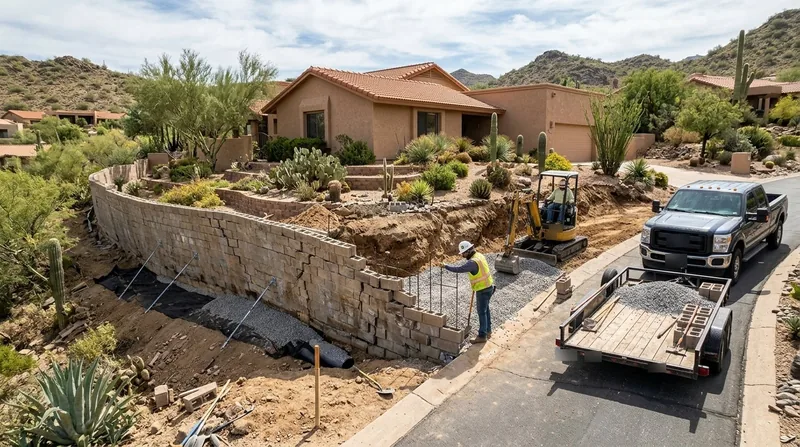




Phoenix homeowners face a unique challenge when retaining walls begin to lean, bulge, or fail outright. The desert valley's flat terrain masks serious subsurface hazards: caliche hardpan that traps water behind walls, pockets of expansive clay that shift with monsoon rains, and flash flooding through washes that can destabilize foundations overnight. Whether your wall is a stucco-faced CMU structure in Encanto-Palmcroft, a 1970s railroad tie wall in Maryvale, or a segmental block installation on a foothills lot in Ahwatukee, leaning and collapsed wall repair demands immediate, expert response. We provide emergency stabilization, drainage correction, and full reconstruction to restore safety and property value. Call us at (480) 494-4792 for same-day assessment, or learn more about our full retaining wall repair services.
Why Retaining Walls Fail in Phoenix: Monsoons, Caliche, and Water Pressure
Phoenix's desert climate creates perfect conditions for wall failure. Summer monsoons dump inches of rain in minutes, overwhelming drainage systems and pushing hydrostatic pressure against the back of walls. Caliche hardpan, a cement-like layer common in Phoenix soil, prevents water from draining naturally and forces it to accumulate behind the wall face. Expansive clay swells when wet and shrinks in the heat, cracking footings and destabilizing the entire structure. Flood irrigation on older Arcadia lots soaks the base of walls. Termites attack timber walls from the inside out. All of this unfolds under relentless white summer heat and golden desert evenings that accelerate material fatigue.
- Caliche and expansive clay trap water and create lateral pressure that pushes walls outward and downward.
- Monsoon cloudbursts overwhelm surface and subsurface drainage, forcing water to back up against the wall face.
- Flood irrigation, common on 1950s Arcadia properties, saturates soil at the wall base and erodes the footing.
- Timber and railroad tie walls rot or suffer termite damage, losing structural integrity from the inside.
- Poured concrete and CMU walls crack under thermal stress and hydrostatic load, allowing water to seep through.
Early signs include a visible tilt, horizontal cracks, efflorescence (white mineral staining), or standing water at the base. Waiting for the problem to worsen puts your home, driveway, and landscaping at risk.
Key info: A leaning wall in Scottsdale or Chandler often reflects caliche buildup and poor subsurface drainage. We correct both the structural tilt and the water management so the repair holds through the next monsoon season and beyond.
For more details on how drainage failure triggers collapse, see our guide to retaining wall drainage and hydrostatic pressure relief. Arizona's Department of Housing also publishes guidance on structural integrity and property line setbacks; verify local requirements with your city building department before any repair work begins.
How We Stabilize and Repair Leaning Walls in Phoenix
Our repair process begins with a site inspection to identify the root cause: water pressure, foundation failure, soil movement, or material degradation. We then choose the most cost-effective stabilization method, whether that's installing tieback anchors to anchor the wall to stable soil deeper in the ground, rerouting drainage to relieve hydrostatic pressure, or rebuilding sections of the wall that are beyond repair. Each approach is tailored to the wall's material, age, and the specific failure mode affecting your property.
- We excavate behind and around the wall to expose the footing and assess soil conditions, caliche depth, and drainage problems.
- We install French drains or perforated pipes to intercept and redirect water away from the wall face.
- We drill and install helical or mechanical tieback anchors into stable soil, then connect them to the wall with steel cables or rods.
- We backfill with engineered gravel and drainage material, compacting in lifts to prevent future settlement.
- We rebuild or repair the wall face, matching existing material and finish where the wall is being retained.
- We verify proper drainage slope and test the repair under simulated load before final sign-off.
This methodical approach prevents the wall from leaning further while addressing the water and soil conditions that caused the failure in the first place.
Real example: A 1970s stucco-faced CMU wall in Paradise Valley began leaning inward after a series of heavy monsoons. We installed four tieback anchors, added a French drain system behind the wall, and sealed cracks in the face. The wall is now plumb and has remained stable through two more monsoon seasons.
Learn more about our approach to slope stabilization and erosion control, which often works in tandem with wall repair on hillside properties.
Repair Methods and When to Use Them
| Approach | Description | Best for |
|---|---|---|
| Tieback Anchors | Steel cables or rods drilled deep into stable soil and connected to the wall face with plates and fasteners. | Walls leaning 1 to 3 inches, moderate hydrostatic pressure, walls you want to keep in place. |
| Drainage Correction | French drains, perforated pipes, and gravel backfill to intercept and redirect water away from the wall base. | Walls failing due to water buildup, caliche blockage, or poor original drainage design. |
| Partial Rebuild | Remove and rebuild the upper 2 to 4 feet of wall, reset the footing, and install new drainage and tieback anchors. | Walls with severe cracking, material decay, or a footing that has settled more than 2 inches. |
| Full Replacement | Complete removal and reconstruction using modern materials, proper drainage, and engineered design where required. | Walls that are unsafe, failing on multiple fronts, or too damaged to repair cost-effectively. |
| Epoxy Crack Injection | High-pressure injection of epoxy resin into cracks to seal them and restore bond between concrete or masonry units. | Poured concrete or CMU walls with hairline to moderate cracks, no active water seepage or movement. |
Leaning and Collapsed Wall Repair Cost in Phoenix: What to Expect
The cost of leaning and collapsed wall repair in Phoenix ranges from $2,500 for minor stabilization and drainage work to $15,000 or more for full wall replacement or complex tieback anchor systems. Several factors drive the final price: the wall's height and length, the severity of the lean or bulge, soil and caliche conditions, access for equipment, whether the wall is in a residential or commercial zone, and whether an engineered design is required by your local building department.
A small wall (under 6 feet tall, 20 feet long) with a minor tilt and good access might cost $3,500 to $6,000 for anchors and drainage. A taller wall (8 to 12 feet), a more severe lean, or poor access can push the cost to $8,000 to $12,000. Full replacement of a collapsed wall runs $12,000 to $20,000 depending on material choice and site conditions. Permitting, engineering drawings (if required), and any tree or landscape removal add to the total.
We always recommend getting 2 to 3 estimates from licensed contractors so you can compare scope, timeline, and warranty. Avoid the cheapest bid if it skips drainage correction or tieback installation; a quick fix now often leads to a bigger failure later. Our estimates are free and binding for 30 days, and we respond within 24 hours. Call (480) 494-4792 or visit our pricing page for detailed breakdowns by wall type and repair method.
Leaning and Collapsed Wall Repair Near Me: What Phoenix Homeowners Should Know When Hiring
Choosing the right contractor for wall repair is as important as choosing the repair method itself. Look for a company that is licensed and insured in Arizona, has verifiable references from recent jobs in your area (Phoenix, Scottsdale, Tempe, Gilbert, or wherever you are), and can explain their process and warranty in plain language. Ask whether they pull permits themselves or expect you to, and confirm that they understand local setback requirements and HOA restrictions that may apply to your property. A reputable contractor will not pressure you into a decision on the first visit and will provide a written estimate that itemizes labor, materials, and any engineering or permit costs.
- Verify that the contractor holds a current Arizona Contractor License and carries general liability and workers compensation insurance.
- Ask for at least three references from jobs completed in the past 12 months within Phoenix or your specific city.
- Request a written estimate that breaks down the cost of labor, materials, drainage, anchors, and any engineering or permitting.
- Confirm whether the contractor will obtain permits and handle building department inspections, or if you are responsible for those steps.
- Understand the warranty: most structural repairs carry a 1 to 2 year workmanship warranty, and materials carry manufacturer warranties (typically 5 to 10 years for anchors and drainage components).
- Check whether your HOA or local zoning rules require setback distances, heritage tree protections, or design review before work begins.
We handle permitting and engineering drawings as part of our service. Contact us today for a free, no-obligation estimate and a same-day site assessment.
Leaning & Collapsed Wall Repair in Phoenix: Pricing Guide
| Service | Price | Details |
|---|---|---|
| Minor stabilization with tieback anchors | Starting at $2,500 | Small wall, minimal lean, good access, one to two anchors, basic drainage adjustment |
| Tieback anchors plus French drain system | Starting at $5,500 | Medium wall, moderate lean or bulge, full drainage retrofit, four to six anchors, backfill and compaction |
| Partial wall rebuild with anchors and drainage | Starting at $8,500 | Upper section removal and replacement, new footing, engineered design, tieback system, full drainage overhaul |
| Full wall replacement | From $12,000 to $20,000 | Complete demolition and reconstruction, new material choice, engineered design, comprehensive drainage and anchoring system |
| Emergency or same-day stabilization | Call for quote | Expedited response, temporary bracing, temporary drainage, priority scheduling, full repair to follow |
| Estimate and site assessment | Free | No obligation, response within 24 hours, detailed written estimate valid for 30 days, (480) 494-4792 |
Indicative pricing, the exact cost depends on square footage, finish, and site access. Free personalized estimate within 24h at (480) 494-4792.


