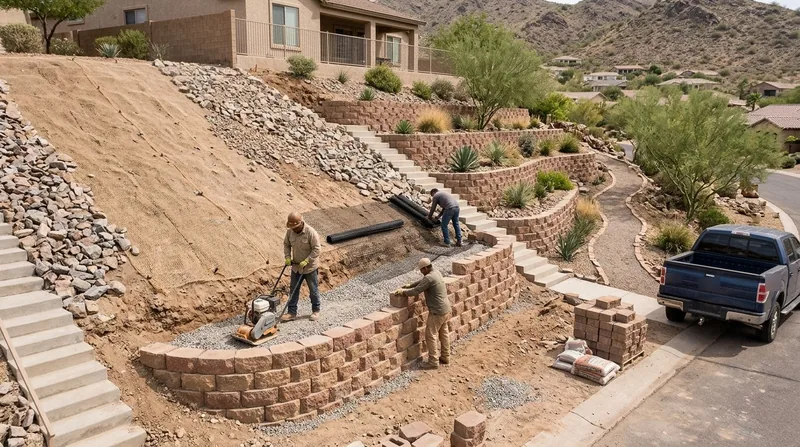




Slope stabilization and erosion control in Phoenix protects hillside homes, driveways, and yards from the relentless forces of desert monsoons, flash flooding through washes, and the slow creep of caliche-laden soil. Phoenix spreads across a flat desert valley ringed by rocky mountain preserves, but many lots climb the foothills of Ahwatukee, Moon Valley, and Desert Ridge, or sit vulnerable along wash banks and cut-fill slopes. When monsoon cloudbursts hit or flood irrigation soaks the base of a hillside, uncontrolled water and unstable soil can undermine foundations, crack pavement, and bury yards. We stabilize slopes with terraced retaining walls, geogrid reinforcement, and proper drainage to stop erosion before it starts. Call us at (480) 494-4792 for a free estimate, or learn more about our retaining wall installation options.
Why Slope Stabilization Matters on Phoenix Hillside and Wash-Side Lots
Hillside parcels and properties near desert washes face unique threats. Caliche hardpan traps water against the soil, creating hydrostatic pressure that pushes slopes outward. Pockets of expansive clay swell when wet and shrink in the summer heat, cracking walls and shifting ground. Monsoon runoff concentrates in washes and channels, eroding banks and destabilizing the footings of homes and retaining walls built too close to the edge. Without proper slope stabilization, driveways crack, pools tilt, and homes settle unevenly.
- We identify zones of active erosion and soil movement using field inspection and, when needed, soil testing.
- We design tiered walls and terraces that break up long slopes and reduce water velocity during heavy rain.
- We install geogrid reinforcement behind walls to lock soil in place and increase the structural capacity of the wall itself.
- We run drainage systems (perforated pipe, gravel backfill, and surface swales) to move water away from the slope and reduce saturation.
- We specify materials and heights that comply with Phoenix city and county building codes, and we pull permits when required.
Proper slope stabilization stops erosion, protects your property value, and prevents costly emergency repairs after a monsoon or flood event.
Key info: Phoenix hillside lots in Ahwatukee, Paradise Valley, and Moon Valley often sit on caliche-heavy clay that traps water. A single monsoon downpour can saturate a slope and trigger movement within hours. Early detection and proper drainage design are the best defense against costly failure.
For more on how we protect slopes and manage water, see our retaining wall drainage service.
External Resource: The City of Phoenix Planning and Development Department publishes grading and erosion control guidelines for hillside development. Check phoenix.gov for current setback requirements and permit thresholds for walls above 4 feet or supporting a surcharge.
How We Stabilize Slopes in Phoenix: Our Process
Slope stabilization in the Phoenix desert requires careful assessment of soil type, water movement, and the specific terrain of your lot. We start with a detailed site visit to understand the slope angle, soil composition (clay, caliche, sand), drainage patterns, and proximity to structures. We then design a custom solution using tiered walls, geogrid, and drainage to lock the slope in place and manage runoff. Our crew builds the walls to code, backfills with compacted engineered fill, and installs drainage to ensure the slope stays stable through monsoons and summer heat cycles.
- We conduct a free on-site inspection, measuring slope angle, soil type, and existing drainage or failure points.
- We design a tiered wall system with geogrid reinforcement and drainage specifications tailored to your lot and soil conditions.
- We obtain any required building permits from the City of Phoenix or your local jurisdiction, verifying setback and height rules.
- We excavate and prepare the footing, ensuring stable bearing on undisturbed soil or caliche below the active erosion zone.
- We construct the retaining wall using block, poured concrete, or natural stone, depending on your site and aesthetic preference.
- We backfill with compacted engineered fill, geogrid layers, and perforated drainage pipe to manage water and prevent re-saturation.
- We grade and finish the slope above and below the wall, and install erosion control matting or landscape if needed.
The entire process typically takes 2 to 4 weeks, depending on slope size, wall height, and permit timelines.
Example: A homeowner in Chandler noticed a 15-foot slope behind her driveway settling and cracking after a heavy monsoon. We installed a 6-foot tiered block wall with geogrid and perforated drainage, stabilizing the slope and protecting the driveway from further movement. The job took 3 weeks, including permits and final grading.
Learn more about our block and segmental retaining walls or explore natural stone wall options for your slope.
Slope Stabilization Methods for Phoenix Terrain
| Approach | Description | Best for |
|---|---|---|
| Tiered Block Walls | Multiple stacked retaining walls stepping down the slope, each 4 to 6 feet high, with drainage and geogrid between tiers. | Long hillside slopes in Ahwatukee, Paradise Valley, and Moon Valley where a single tall wall is impractical or exceeds code limits. |
| Geogrid Reinforcement | High-strength synthetic mesh layers inserted into the backfill behind a wall, anchoring soil and increasing wall capacity by up to 40 percent. | Tall walls (8+ feet), slopes with weak or expansive clay, or sites where surcharge (driveway, structure) loads the wall heavily. |
| Perforated Drainage & Swales | Subsurface perforated pipe running behind the wall, connected to gravel backfill and surface swales that channel water downslope and away from the structure. | Any slope in Phoenix where caliche, clay, or monsoon saturation is a concern. Essential for wash-side and hillside properties. |
| Natural Stone Terracing | Boulder or stacked natural stone walls that blend with the desert landscape, often used in combination with geogrid and drainage for aesthetic and functional stability. | Foothill lots where a natural appearance is desired, or where existing granite and native stone are abundant on the property. |
| Erosion Control Matting | Biodegradable or synthetic mesh laid on exposed slopes to reduce water runoff velocity, prevent soil particle loss, and allow vegetation to establish. | Newly graded slopes, areas above walls, and wash banks where rapid stabilization and re-vegetation are needed before next monsoon. |
Slope Stabilization and Erosion Control Cost in Phoenix: What to Expect
The cost of slope stabilization and erosion control in Phoenix depends on slope length, height, soil type, drainage complexity, and whether geogrid and multiple tiers are needed. A simple single-wall project on a small residential slope may run $3,500 to $8,000, while a tiered system with geogrid and full drainage on a larger hillside can range from $12,000 to $35,000 or more. Factors that increase cost include soil testing, engineered drawings (often required for walls taller than 6 feet or supporting a surcharge), difficult access, caliche removal, and permit delays. We always start with a free estimate that includes a site inspection, soil assessment, and a detailed scope of work. Getting 2 to 3 estimates from licensed contractors helps you compare approach, materials, and timeline so you can make an informed decision.
Visit our pricing page for more detail on cost factors and typical project ranges.
Slope Stabilization and Erosion Control Near Me: What to Look for When Hiring a Retaining Wall Contractor in Phoenix
Choosing the right contractor for slope stabilization is critical. Look for a licensed and insured company with a proven track record on hillside and wash-side projects in Phoenix, Scottsdale, Tempe, Mesa, Chandler, Gilbert, and surrounding areas. Ask for references from recent slope stabilization jobs, and request to see photos of completed tiered walls, drainage installations, and long-term performance. Verify that the contractor understands Phoenix building codes, permit requirements for walls above 4 feet, and setback rules for properties near washes or in foothill zones. Confirm that the estimate includes site inspection, soil assessment, drainage design, and all labor and materials to completion. Check with your HOA if you live in a community with architectural review, as some neighborhoods restrict wall height or material type. Finally, ensure the contractor carries liability insurance and workers compensation, and ask for proof before work begins.
- Verify Arizona contractor license and confirm current insurance coverage with a certificate of insurance.
- Ask for 3 to 5 local references from homeowners who had slope stabilization or tiered walls built in the past 2 years.
- Request a written estimate that breaks down labor, materials, permits, and timeline so there are no surprises.
- Confirm that the contractor will handle all permit applications and coordinate with the City of Phoenix or your local building department.
- Ask whether the contractor uses geogrid, perforated drainage, and engineered fill backfill as standard practice for hillside slopes.
- Get clarity on warranty coverage for the wall (typically 5 to 10 years on materials and workmanship) and what is and is not covered.
A qualified contractor will answer your questions directly, provide a detailed site inspection, and explain their approach so you understand what is being built and why.
Ready to protect your slope? Contact us today for a free estimate and expert advice tailored to your Phoenix property.
Slope Stabilization & Erosion Control in Phoenix: Pricing Guide
| Service | Price | Details |
|---|---|---|
| Free Estimate | Free | On-site inspection, soil assessment, slope measurement, and preliminary design recommendation with no obligation to book |
| Small Slope Stabilization | Starting at $3,500 | Single retaining wall under 6 feet, basic drainage, and grading for slopes under 20 feet long in accessible locations |
| Tiered Slope Stabilization | Starting at $12,000 | Multiple terraced walls with geogrid reinforcement, perforated drainage, and compacted backfill for hillside slopes 20 to 50 feet long |
| Complex or Large-Scale Slope Project | On estimate | Engineered design, soil testing, caliche removal, steep terrain, multiple tiers, or surcharge loads require custom quote after site visit |
| Travel | Included | No mileage fee or travel charge for Phoenix, Scottsdale, Tempe, Mesa, Chandler, Gilbert, and surrounding areas |
Indicative pricing, the exact cost depends on square footage, finish, and site access. Free personalized estimate within 24h at (480) 494-4792.


