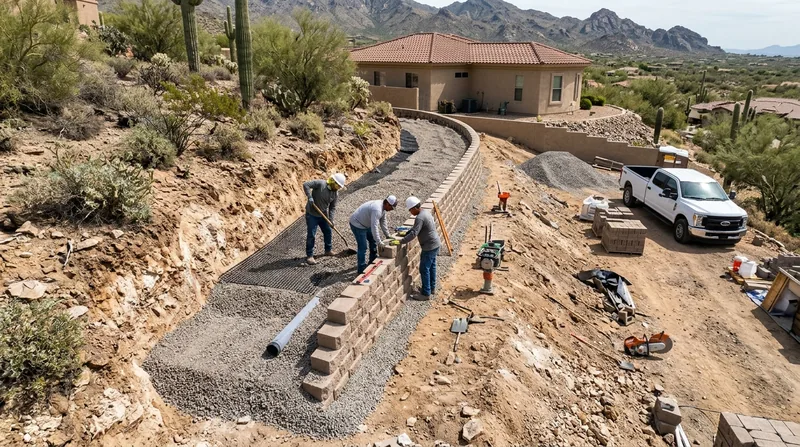




Retaining Wall Installation in Phoenix demands a deep understanding of desert soils, monsoon drainage, and the unique terrain that defines this sprawling valley city. From the 1950s slump-block ranches of Arcadia to the foothills homes climbing Ahwatukee and Moon Valley, Phoenix homeowners face a common challenge: holding back earth on hillside lots, stabilizing wash banks, and terracing yards across caliche-laden ground. Our team designs and builds new walls on solid footings cut through that caliche hardpan, sized for the cloudbursts and flash flooding that come with Arizona's monsoon season. Whether you need a short landscape wall or a tall structural retaining wall to support a driveway, we engineer the drainage and foundation work that keeps your property stable for decades.
Why Retaining Wall Installation Matters in Phoenix's Desert Landscape
Phoenix's flat valley floor and surrounding foothills create two distinct wall challenges. Hillside lots in Paradise Valley, Fountain Hills, and Ahwatukee require walls to hold cut slopes and prevent erosion during monsoon runoff. Flat lots across Maryvale, Encanto, and Arcadia need walls to terrace yards, contain fill for driveways, and manage water that pools against expansive clay layers beneath the surface. The biggest threat to walls here is water: caliche hardpan traps moisture at the base, monsoon cloudbursts overwhelm poor drainage, and flood irrigation soaks the foundation. A properly installed wall with gravel backfill and a drainage system sized for those heavy rains is the difference between a wall that lasts 40 years and one that fails in five.
- We cut footings deep through caliche to reach stable soil and prevent settling.
- We size drainage systems for Phoenix monsoon intensity, not average rainfall.
- We engineer walls to handle surcharge loads like driveways and structures.
- We pull permits where required and coordinate with your local building department.
These steps ensure your wall holds firm against the heat, water, and soil conditions unique to the Phoenix area.
Key info: Many Phoenix jurisdictions require a permit for walls above 4 feet or when supporting a surcharge like a driveway. Setback and property-line rules vary by city, so we verify requirements with your local building department before breaking ground. For details on your specific location, check with the City of Phoenix Development Services or your city's planning office.
For walls showing signs of stress, lean, or seepage, see our Leaning and Collapsed Wall Repair service or explore Retaining Wall Repair options.
How We Install Retaining Walls in Phoenix: Process and Precision
A solid retaining wall starts with a solid plan. We begin with an on-site assessment to understand your soil type, slope angle, drainage patterns, and any surcharges like a driveway or structure. From there, we design a wall tailored to your lot, pull permits if needed, and execute the work in phases that minimize disruption to your yard. Every job includes proper footing depth, compacted backfill, and drainage sizing that handles Phoenix's monsoon season, not just routine rain.
- We assess your soil, slope, and drainage conditions on a free site visit.
- We design the wall height, material, and footing depth based on your site and local code.
- We obtain permits from your city or county if the wall exceeds height or surcharge thresholds.
- We excavate and cut the footing through caliche to competent soil.
- We build the wall to spec, backfill with gravel, and install drainage to shed water away from the base.
- We compact and finish the site, leaving your yard ready for landscaping.
This methodical approach prevents the settling, seepage, and failure that plague hastily built walls across the Phoenix valley.
Local example: A homeowner in Gilbert needed a 5-foot segmental block wall to hold back a terraced desert yard and support a new driveway apron. We cut the footing 3 feet into caliche, installed a gravel-filled drainage trench, and backfilled with compacted material. The wall now stands firm through summer monsoons and winter flooding, with zero settlement or seepage after two seasons.
For complex slope conditions or erosion control, consider our Slope Stabilization and Erosion Control service.
Retaining Wall Installation Methods for Phoenix Soils and Terrain
Phoenix homeowners have several material and construction options, each suited to different site conditions, budgets, and aesthetics. We work with concrete, segmental block, natural stone, and timber, and we engineer each approach to handle the caliche, expansive clay, and monsoon water that define this region. The method we recommend depends on your wall height, the soil behind it, access for equipment, and your design preference.
| Approach | Description | Best for |
|---|---|---|
| Segmental Block (SRW) | Interlocking concrete units stacked and backfilled with gravel. Fast, flexible, and highly permeable for drainage. | Mid-height walls (3-8 feet), sloped sites, DIY-friendly finishes, homeowners wanting modern aesthetics. |
| Poured Concrete | Monolithic reinforced concrete wall cast in place. Extremely strong, long-lasting, can be stucco-faced or left natural. | Tall walls (8+ feet), high surcharge loads (driveways, structures), sites with poor soil, maximum durability. |
| Boulder and Natural Stone | Dry-stacked or mortared native granite and stone. Blends with Phoenix's desert aesthetic, excellent drainage. | Foothills homes, hillside lots, homeowners prioritizing natural appearance, shorter terracing walls. |
| CMU Block (Concrete Masonry Unit) | Standard concrete blocks, often stucco-faced to match 1950s-70s Phoenix homes. Economical, proven, easily repaired. | Replacement of failed walls, budget-conscious projects, integration with existing masonry on the property. |
Each method requires proper drainage design and footing work to survive Phoenix's caliche and monsoon season. We engineer the backfill and weeping system for your chosen material.
Retaining Wall Installation Cost in Phoenix: What to Expect
Retaining wall installation costs in Phoenix range widely depending on wall height, material, soil conditions, and site access. A simple 3-foot segmental block wall on level ground with good access runs significantly less than a 10-foot poured concrete wall on a hillside lot with caliche removal. We provide cost estimates after an on-site assessment because the true price drivers are buried in your soil, slope, and footing requirements.
Most homeowners see pricing starting at $30 per square foot for basic segmental block walls with standard drainage. Poured concrete, natural stone, and walls requiring deep caliche excavation or engineered drawings run higher. A 4-foot wall spanning 50 feet (200 square feet) might start around $6,000 at the lower end, while a 10-foot engineered concrete wall in a foothills lot with significant caliche removal could easily exceed $20,000. Factors that move the price include wall height, material choice, footing depth through caliche, drainage complexity, proximity to structures or property lines, and whether engineered drawings are required by your local building department.
The best approach is to get 2 or 3 free estimates from licensed contractors who visit your site and explain what drives their pricing. This reveals which contractors understand Phoenix soils and which are simply guessing. Visit our pricing page for detailed breakdowns by wall type and material, or call us at (480) 494-4792 for a free on-site estimate within 24 hours.
Retaining Wall Installation Near Me: What to Look for When Hiring a Phoenix Contractor
Choosing the right contractor makes the difference between a wall that fails in five years and one that lasts 40. Look for a contractor who is licensed and insured, understands Phoenix permitting rules, pulls permits on your behalf, and can explain how they'll handle caliche, drainage, and footing depth. Ask for references from recent jobs in your neighborhood, and verify that the contractor has experience with your specific wall type and soil condition.
Here's what to verify before you hire:
- Confirm the contractor holds an active Arizona Contractor's License and carries liability and workers' compensation insurance.
- Ask whether they pull permits or expect you to handle that step, and verify they know your city's wall height and setback rules.
- Request references from at least two recent retaining wall jobs in Phoenix or your specific neighborhood.
- Discuss how they handle footing depth through caliche and what drainage system they recommend for monsoon conditions.
- Get a written estimate that breaks down labor, materials, permits, and any surcharges for difficult access or soil removal.
- Check whether your HOA (if applicable) requires approval for wall height, material, or setback before construction begins.
A contractor who takes time to assess your site, explain the work, and answer questions upfront is far more likely to deliver a wall that performs. Contact us for a free consultation and estimate.
Retaining Wall Installation in Phoenix: Pricing Guide
| Service | Price | Details |
|---|---|---|
| Segmental Block Wall (3-6 feet) | Starting at $30/sq ft | Includes footing, block, gravel backfill, and drainage; height and caliche depth are primary cost drivers |
| Poured Concrete Wall (6-12 feet) | Starting at $45/sq ft | Reinforced concrete, engineered design, stucco finish optional; surcharge loads and footing depth through caliche increase cost |
| Boulder and Natural Stone Wall | Starting at $50/sq ft | Dry-stacked or mortared granite; material sourcing, stone size, and site access significantly affect final price |
| Engineered or Complex Installation | On estimate | Tall walls, difficult access, heavy surcharge, or significant caliche removal require site visit and engineered drawings |
| Permit and Design Fees | Included | We handle city permitting and provide design drawings as part of our installation service, no separate charge |
| Free Estimate | No obligation | On-site assessment and written quote within 24 hours; call (480) 494-4792 to schedule your visit |
Indicative pricing, the exact cost depends on square footage, finish, and site access. Free personalized estimate within 24h at (480) 494-4792.


