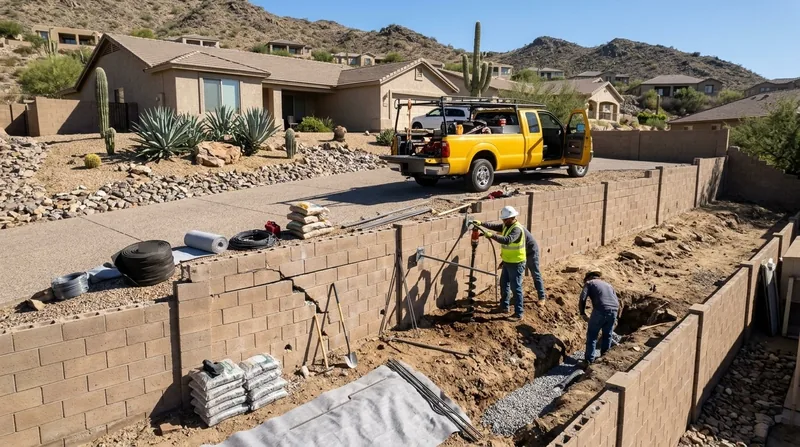




Retaining Wall Repair in Phoenix stops failure before collapse costs you thousands. Phoenix spreads across flat desert terrain ringed by rocky foothills, where retaining walls hold back cut slopes, stabilize driveways, and terrace desert landscaping on properties from Encanto-Palmcroft to Ahwatukee. Most walls here are stucco-faced CMU, slump block, poured concrete, segmental block, native granite boulders, or 1970s-80s railroad ties. They fail fast under Phoenix's harsh conditions: caliche hardpan that traps monsoon water, pockets of expansive clay, flash flooding through washes, and flood irrigation soaking the base. A leaning, bowing, or cracked wall is not cosmetic. It signals active movement that will accelerate into collapse without intervention. Phoenix Retaining Wall diagnoses the root cause, repairs drainage problems, installs tieback anchors, and rebuilds sections that stop failure before it becomes a structural emergency.
Why Retaining Wall Repair Matters in Phoenix's Desert Landscape
Phoenix's combination of flat valley lots with hillside parcels and wash-adjacent properties creates unique wall stress. Most residential walls face three dominant failure modes: water infiltration from monsoon cloudbursts and flood irrigation that saturates caliche hardpan below the footing, causing settlement and tilt; expansive clay pockets that swell under moisture and push walls outward; and aging timber walls (railroad ties, treated lumber) that weaken from termites and sun exposure. A wall that leans even slightly is already moving. Waiting for it to worsen means exponentially higher repair or replacement costs, plus risk to property, vehicles, and people below the wall.
- We identify whether the wall is settling, tilting, or bowing, and trace the cause to drainage failure, soil expansion, or structural fatigue.
- We correct drainage problems by installing or repairing perforated pipe, gravel backfill, and weep holes to prevent water from building pressure behind the wall.
- We install tieback anchors, soil nails, or shotcrete facing to arrest movement without requiring full demolition.
- We rebuild failed sections, repair cracked concrete or block, and stabilize leaning walls using techniques scaled to the wall's material and height.
Early repair keeps your wall standing and your property safe. Ignoring a leaning wall guarantees collapse and liability.
Key info: A wall leaning more than 1 inch per 10 feet of height is actively failing. In Phoenix, this typically happens within 2-5 years of the first visible crack or tilt. Homeowners in Ahwatukee, Paradise Valley, and Moon Valley often spot failures after monsoon season when saturation peaks.
For more on how drainage failure accelerates wall collapse, see our Retaining Wall Drainage service page.
For permit and code questions, the City of Phoenix Building and Safety Department publishes retaining wall standards at phoenix.gov/pocketgov. Many jurisdictions require a permit for walls above 4 feet measured from the footing, or when a wall supports a surcharge such as a driveway or structure. Always verify local thresholds before starting work.
How We Repair Retaining Walls in Phoenix: A Step-by-Step Approach
Our repair process begins with a thorough on-site assessment. We photograph the wall, measure tilt and cracking patterns, probe soil conditions, and trace drainage paths. We then present you with a diagnosis and repair options ranging from drainage correction alone to anchoring, facing, or partial rebuild. We handle all permitting and engineering drawings required by your local building department. Work proceeds methodically to minimize disruption and ensure the wall stabilizes permanently.
- We inspect the wall, surrounding soil, and existing drainage to identify the cause of movement.
- We obtain or prepare engineered drawings if required by your local building department.
- We obtain a permit and schedule work at your convenience.
- We install drainage correction, tieback anchors, or facing as specified in the repair plan.
- We monitor the wall over the following weeks to confirm stabilization.
- We provide a warranty on repair work and recommend annual inspections for walls over 6 feet tall.
Repair timelines range from one day for drainage correction to two weeks for anchoring or partial rebuild, depending on wall height, material, and access.
Example: A homeowner in Chandler noticed a 6-inch lean in her 8-foot stucco CMU wall after heavy monsoon rains. Our crew installed a perimeter drain system, gravel backfill, and three tieback anchors. The wall stabilized within two weeks. Total cost was $4,200. Without repair, the wall would have collapsed within 18 months, requiring full replacement at $15,000+.
Learn more about our Leaning and Collapsed Wall Repair service for advanced stabilization techniques.
Retaining Wall Repair Methods and Techniques
| Approach | Description | Best for |
|---|---|---|
| Drainage Correction | Install perforated pipe, gravel backfill, and weep holes to redirect water away from the wall footing. | Walls tilting or settling due to water pressure, especially after monsoon season. |
| Tieback Anchors | Drill horizontal anchors into stable soil or rock behind the wall and tension them to pull the wall back to plumb. | Leaning 4-12 foot walls that cannot be demolished due to site constraints or cost. |
| Shotcrete Facing | Spray reinforced concrete over the existing wall face to bond cracks, reinforce the structure, and restore appearance. | Cracked or spalling concrete or CMU walls that are structurally sound but deteriorating. |
| Partial Rebuild | Remove and rebuild the top section or base of the wall using modern materials and proper drainage and footing. | Walls with localized failure, failed timber sections, or inadequate original construction. |
| Soil Nails | Drive reinforced steel nails into the soil behind the wall and attach them to a facing to stabilize the slope. | Cut slopes or embankments at risk of slumping or erosion. |
| Full Replacement | Demolish the existing wall and build a new one with proper footing, drainage, and engineered design. | Walls that have failed catastrophically or where repair cost approaches replacement cost. |
Retaining Wall Repair Cost in Phoenix: What to Expect
Retaining wall repair costs in Phoenix range widely based on the wall's size, material, cause of failure, and repair method. A drainage correction on a 4-foot CMU wall might run $1,500 to $2,500. Tieback anchors for a 8-foot leaning wall typically cost $3,500 to $6,000. Shotcrete facing or partial rebuild can range from $4,000 to $10,000 depending on wall length and height. Full replacement of a failed wall is generally $8,000 to $20,000+. The key factors that move the price are wall height, linear footage, soil conditions, access for equipment, and whether the wall requires engineered drawings and permitting.
We recommend getting two or three estimates before committing. A reputable contractor will explain what's driving the cost and offer options at different price points. The cheapest estimate is not always the best; a contractor who skips drainage correction or uses inadequate anchoring will leave you with a wall that fails again in two years.
Visit our Pricing page for a detailed breakdown of repair costs by wall type and size. Call us at (480) 494-4792 for a free, no-obligation estimate. We respond within 24 hours and can often schedule an inspection within the same week.
Retaining Wall Repair Near Me: What Phoenix Homeowners Should Know When Hiring
Hiring the right contractor for retaining wall repair is critical. Your wall is a structural element that protects your property and the property below. A contractor who cuts corners on drainage, anchoring, or footing depth will sell you a repair that fails within a few years. Before you hire, verify that the contractor is licensed and insured in Arizona, ask for references from recent wall repairs in your area, and request to see the engineered drawings or design calculations if the wall is over 4 feet tall or supports a surcharge such as a driveway.
Ask about permitting. If your local building department requires a permit (most do for walls over 4 feet), your contractor should handle it. If you have an HOA, check your covenants; some communities restrict wall materials or heights. Get everything in writing: the scope of work, the repair method, the timeline, the warranty, and the total price. Do not hire based on a phone estimate or a quote from a contractor who did not visit the site in person.
We provide detailed engineered drawings, handle all permitting, and warranty our work. Contact us for a free on-site assessment and repair estimate. We serve Phoenix, Scottsdale, Tempe, Mesa, Chandler, Gilbert, Peoria, Surprise, Goodyear, Avondale, Buckeye, Paradise Valley, Fountain Hills, Cave Creek, Queen Creek, and Apache Junction.
Retaining Wall Repair in Phoenix: Pricing Guide
| Service | Price | Details |
|---|---|---|
| Drainage Correction | Starting at $1,500 | Perforated pipe, gravel backfill, and weep holes installed to prevent water pressure failure behind wall |
| Tieback Anchors (3-5 anchors) | Starting at $3,500 | Horizontal anchors drilled and tensioned to arrest tilt in 6-10 foot leaning walls without demolition |
| Shotcrete Facing or Partial Rebuild | Starting at $4,000 | Reinforced concrete facing or rebuilding top or base section, cost scales with wall height and linear footage |
| Full Wall Replacement | On estimate | Complete demolition and new construction with proper footing and drainage requires site visit and engineering assessment |
| Travel and Site Inspection | Included | No mileage fee or separate call charge for Phoenix and surrounding service areas within 30 miles of Phoenix |
| Free Estimate | Free | On-site assessment, diagnosis, and repair options provided at no cost, response within 24 hours at (480) 494-4792 |
Indicative pricing, the exact cost depends on square footage, finish, and site access. Free personalized estimate within 24h at (480) 494-4792.


