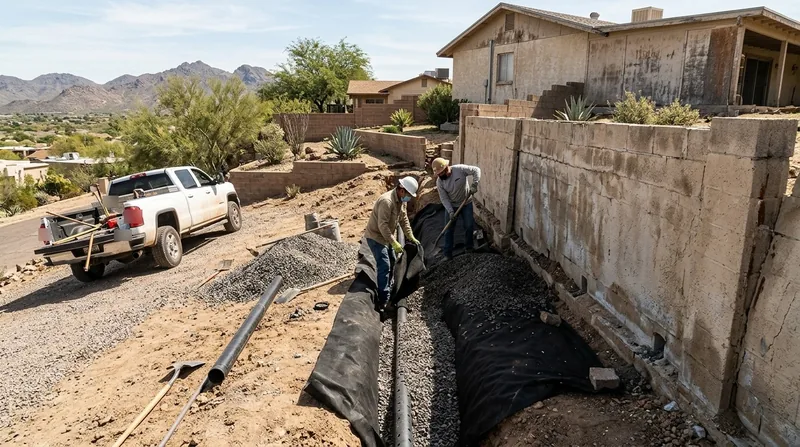




Retaining Wall Drainage in Phoenix is not a luxury add-on, it is the difference between a wall that stands for decades and one that fails in five years. Phoenix sits in a flat desert valley ringed by rocky foothills, where most residential lots spread across flood-irrigated Arcadia ranches, 1950s slump-block neighborhoods, and newer homes climbing the Ahwatukee and Moon Valley slopes. Every one of those walls, whether stucco-faced CMU, segmental block, poured concrete, or aging railroad ties, faces the same enemy: water trapped behind the wall. Monsoon cloudbursts, landscape irrigation, and caliche hardpan that blocks natural drainage all create hydrostatic pressure that pushes walls outward, cracks them, and eventually topples them. A properly designed drainage system removes that pressure before it destroys your wall, your driveway, or your foundation.
Why Drainage Fails in Phoenix: The Desert Wall Problem
Phoenix's desert climate and flood-irrigated soil create drainage conditions that are unique and unforgiving. Unlike coastal regions where rain drains quickly, Phoenix's caliche hardpan and pockets of expansive clay trap moisture directly behind retaining walls. Monsoon season brings violent cloudbursts that saturate the slope above your wall in minutes. Landscape irrigation at the top of a wall soaks the soil for hours. That water has nowhere to go except backward into the wall, building pressure that pushes outward on the face with thousands of pounds of force per linear foot. Walls without proper drainage crack, lean, bow, and fail.
- Hydrostatic pressure from trapped water is the single largest cause of retaining wall failure in Phoenix.
- Caliche hardpan and clay layers prevent natural drainage and force water to accumulate behind the wall.
- Monsoon runoff and landscape irrigation both saturate the soil faster than it can drain naturally.
- Walls without weep holes, French drains, or gravel backfill fail within 5 to 10 years under Phoenix conditions.
- A proper drainage system extends wall life to 30, 40, or 50 years and prevents costly repairs or replacement.
Getting drainage right the first time is far cheaper than repairing a leaning or collapsed wall later.
Key info: A homeowner in Scottsdale with a 1970s slump-block wall backing a tiered desert landscape discovered water running down the inside face during monsoon season. The wall had no weep holes and no drainage layer. Within two years, the wall leaned 4 inches out of plumb. A new drainage system with French drain, weep holes, and gravel backfill cost $8,500 but saved the wall and prevented a $35,000 replacement.
For more on what causes wall failure, see our leaning and collapsed wall repair page.
For more information on drainage requirements and best practices, consult the City of Phoenix Building and Development Services or your local building department, which can clarify permit and inspection requirements for your specific wall height and location.
How We Install Retaining Wall Drainage: Step by Step
A complete drainage system works in layers, each one removing water before it builds pressure. We start by exposing the back of the wall and assessing the soil composition and existing drainage (or lack of it). We then install a gravel layer directly against the wall to prevent fine soil particles from clogging the drainage path. Behind that, we place perforated drain pipe or a French drain system that collects water and directs it downslope or to a discharge point. We add weep holes through the wall face to allow water that does accumulate to escape. Finally, we backfill with drainage-friendly gravel and soil, sloping it away from the wall to shed surface water. The entire system works together to keep hydrostatic pressure near zero.
- We expose the back face of the wall and inspect the existing soil, caliche, and any clay layers that block drainage.
- We install a gravel filter layer against the wall to prevent soil fines from migrating into the drain system.
- We lay perforated drain pipe along the base of the wall, sloped to direct water away from the structure.
- We drill or cut weep holes through the wall face at 4 to 6 foot intervals to allow trapped water to escape.
- We backfill behind the wall with drainage-grade gravel and compacted soil, sloped away from the wall to shed surface runoff.
- We route the drain outlet to daylight, a swale, or a catch basin so water leaves the site and does not reaccumulate.
This layered approach keeps your wall dry and pressure-free, no matter how hard the monsoon rains.
Local example: A Mesa homeowner had a 12-foot poured concrete retaining wall that supported a driveway. After three monsoon seasons, the wall began to bow and crack. We exposed the back, removed compacted caliche and clay, installed a French drain with perforated pipe, added weep holes every 5 feet, and backfilled with drainage gravel. The wall stopped moving within weeks, and the homeowner avoided a $40,000 replacement.
Learn more about our retaining wall repair services and how we address existing drainage problems.
Drainage Methods and Materials: What Works in Phoenix
| Approach | Description | Best for |
|---|---|---|
| French Drain System | Perforated drain pipe laid at the base of the wall, wrapped in filter fabric, and surrounded by drainage gravel. Water flows into the pipe and exits downslope. | Most common and reliable method for walls in Phoenix. Handles monsoon runoff and irrigation seepage effectively. |
| Weep Holes | Holes drilled or cored through the wall face, typically 4 to 6 inches in diameter, spaced 4 to 6 feet apart. Allow water trapped behind the wall to drain outward. | Essential for all walls. Often paired with French drains for redundancy and maximum water removal. |
| Drainage Gravel Backfill | Clean, drainage-grade gravel (3/4 inch to 1.5 inch minus) placed behind the wall instead of compacted soil. Allows water to flow freely toward the drain system. | All new walls and repairs. Prevents caliche and clay from blocking water movement in Phoenix's native soil. |
| Filter Fabric and Geocomposite | Non-woven fabric or composite material placed between the wall and gravel backfill. Prevents fine soil particles from migrating into the gravel and clogging the drain. | Protects the drainage system and ensures long-term performance, especially in walls taller than 8 feet. |
| Slope and Surface Drainage | Grading the soil surface behind the wall to slope away and shed water downhill. Reduces the amount of water that infiltrates into the soil in the first place. | First line of defense for all walls. Especially critical in Phoenix where irrigation and monsoon water can saturate soil in hours. |
Every drainage system in Phoenix should include at least French drain, weep holes, and gravel backfill. For taller walls or those supporting structures like driveways, we add filter fabric and geocomposite for added protection. Surface grading ensures water sheds away before it ever reaches the wall.
Retaining Wall Drainage Cost in Phoenix: What to Expect
Drainage work on an existing wall typically starts at $2,500 for a small to medium wall (under 50 linear feet) with straightforward access. That price covers French drain installation, weep holes, gravel backfill, and filter fabric. For larger walls, walls in difficult terrain, or walls that require significant excavation to expose the back face, costs rise quickly. A 100-foot wall with complex drainage routing can run $8,000 to $15,000 or more. The key factors that move the price are wall length, wall height, site access, soil conditions (caliche hardpan requires extra excavation), and whether the wall is already leaning or bowing (which adds structural complexity).
We always recommend getting two or three estimates from licensed contractors so you can compare scope, materials, and price. Some contractors cut corners on filter fabric or gravel depth to save money, and those walls fail again within a few years. A complete, properly installed drainage system costs more upfront but saves you from a $30,000 to $50,000 wall replacement in a decade.
Visit our pricing page for a detailed breakdown of drainage costs by wall size and condition, or call us at (480) 494-4792 for a free estimate on your specific wall.
Retaining Wall Drainage Near Me: What Phoenix Homeowners Should Know When Hiring
Hiring the right contractor for retaining wall drainage is as important as the work itself. A contractor who skips the French drain or uses cheap gravel will leave you with a wall that fails again in a few years. Before you hire, verify that the contractor is licensed and insured in Arizona and carries general liability and workers compensation coverage. Ask for references from homeowners in Phoenix, Scottsdale, Mesa, or Gilbert where they have done drainage work, and call at least two of them. Understand your local permit requirements, especially if your wall is taller than 4 feet or supports a driveway or structure. Your city or county building department can tell you whether an engineered drawing is required and whether the drainage system will be inspected before backfill.
- Verify the contractor holds an active Arizona contractor license and carries current general liability and workers compensation insurance.
- Request written references from at least two recent drainage jobs in your area, and contact those homeowners to ask about the work quality and whether the wall has remained stable.
- Confirm permit requirements with your local building department before work begins, as drainage systems may be inspected before backfill.
- Get the scope of work in writing, including materials (French drain size, filter fabric type, gravel depth), wall length, and any surface grading or outlet routing.
- Ask whether the contractor will expose the entire back face and assess soil conditions before quoting, or whether they are giving a price sight-unseen (a red flag).
- Understand the warranty: reputable contractors offer at least a one-year warranty on workmanship and often longer on materials.
A contractor who is willing to spend time on your free estimate, answer your questions clearly, and put the scope in writing is one you can trust with your wall.
Retaining Wall Drainage in Phoenix: Pricing Guide
| Service | Price | Details |
|---|---|---|
| Small wall drainage (under 50 linear feet) | Starting at $2,500 | French drain, weep holes, gravel backfill, filter fabric. Access and soil conditions may increase cost. |
| Medium wall drainage (50 to 100 linear feet) | Starting at $5,000 | Full French drain system, multiple weep holes, drainage gravel, geocomposite, and surface grading to shed water. |
| Large or complex wall drainage (over 100 linear feet or difficult terrain) | On estimate | Requires site inspection to assess caliche, clay, access, and outlet routing. Price depends on excavation and soil conditions. |
| Existing wall repair with drainage retrofit | Starting at $3,500 | Exposing a failing wall, installing new French drain and weep holes, and backfilling. Leaning walls cost more due to structural work. |
| Travel and estimate | Free estimate, no charge for travel in Phoenix and surrounding service areas | Response within 24 hours. (480) 494-4792. No obligation to book after estimate. |
Indicative pricing, the exact cost depends on square footage, finish, and site access. Free personalized estimate within 24h at (480) 494-4792.


