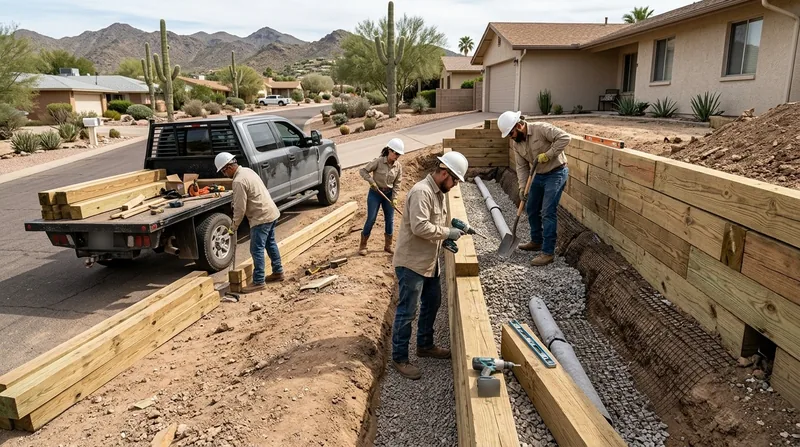




Timber retaining walls in Phoenix offer a budget-friendly way to terrace desert lots, frame garden beds, and manage slope erosion across the valley's flat base and foothills. From the 1950s slump-block ranches of Arcadia to the newer hillside homes climbing Ahwatukee and Moon Valley, timber walls have been a go-to choice for homeowners seeking quick, low-cost containment. However, the Sonoran Desert's intense summer heat, termite pressure, moisture from monsoon flash floods and flood-irrigated yards, and caliche hardpan that traps water create conditions that demand honest talk about timber's real lifespan and when a longer-lasting material makes better financial sense. Phoenix Retaining Wall installs, repairs, and replaces timber walls with a clear eye toward what will actually hold in this climate. We'll walk you through the process, cost expectations, and the right time to choose timber versus concrete, block, or stone.
Why Timber Retaining Walls Matter in Phoenix's Desert Landscape
Timber walls serve a real purpose in Phoenix. They're quick to build, affordable upfront, and work well for low-to-moderate terraces in garden settings where the aesthetic of natural wood fits the landscape. Many Phoenix homeowners, particularly in established neighborhoods like Encanto-Palmcroft and Willo, appreciate the rustic look and flexibility timber provides. However, the desert environment here is unforgiving. Pressure-treated lumber can last 15 to 20 years under ideal conditions, but Phoenix's combination of intense UV exposure, termite colonies, subsurface moisture from caliche and clay pockets, and periodic monsoon saturation accelerates decay and structural failure.
- Timber walls absorb and retain moisture in Phoenix's flood-prone washes and flood-irrigated lots, leading to rot faster than in drier climates.
- Termites and carpenter ants thrive year-round in Arizona's warm desert environment and readily colonize even pressure-treated timber.
- Caliche hardpan and expansive clay common beneath Phoenix lots trap water at the wall base, accelerating failure and requiring robust drainage.
- Summer temperatures exceeding 120 degrees F cause wood to split and warp, compromising wall integrity and allowing soil to migrate through gaps.
- Timber walls above roughly 4 feet may require a permit from your local building department, and engineered drawings are often mandated for tiered or tall installations.
Understanding these realities helps you choose timber when it truly fits your project and budget, and recognize when retaining wall replacement or an alternative material will serve you better long-term.
Key info: A timber wall framing a raised desert garden bed in Chandler or Gilbert may perform well for 12 to 18 years with good drainage and maintenance. The same wall supporting a driveway or terrace in a wash-side lot in Tempe or Apache Junction can fail in 8 to 10 years due to subsurface saturation. Always verify permit thresholds with your local city building department, as rules vary by jurisdiction.
For more on how different materials perform in Phoenix's specific conditions, see our guide to concrete retaining walls and block and segmental retaining walls.
How We Install and Repair Timber Retaining Walls Across Phoenix
Our process begins with a clear site assessment. We evaluate soil composition, drainage patterns, water table depth, and proximity to structures or utilities. In Phoenix, we always account for caliche hardpan, which may require breaking through or installing perforated drainage to prevent water pooling behind the wall. We source pressure-treated lumber rated for ground contact, set posts on solid footings below the frost line or caliche layer, and install perimeter drainage to channel water away from the wall base. Proper installation adds years to timber wall life in this climate.
- We excavate and clear the wall footprint, breaking through caliche if necessary and removing expansive clay or loose soil.
- We set treated posts or timbers on concrete footings below the frost line, ensuring lateral bracing and proper compaction.
- We install perforated drain pipe and landscape fabric behind the wall to redirect groundwater and prevent soil migration.
- We backfill with compacted gravel and native soil, sloping the surface away from the wall to shed monsoon runoff.
- We inspect for termite risk and recommend preventive treatment or regular monitoring, especially in Paradise Valley and Scottsdale lots with mature trees nearby.
Repair work typically involves replacing rotted or termite-damaged sections, reinforcing weak posts, or installing new drainage when existing walls are leaning or showing water damage. See our leaning and collapsed wall repair page for details on emergency stabilization.
Example: A homeowner in Mesa had a 4-year-old timber retaining wall supporting a terraced garden bed begin to bow outward. Inspection revealed termite damage in the lower posts and water pooling behind the wall due to missing drainage. We replaced the damaged posts, installed new perforated drain pipe with fabric, and regraded the backfill. Cost was roughly $1,800 for 20 linear feet, and the wall regained structural integrity. Without repair, it would have collapsed within the next monsoon season.
Timber Retaining Wall Installation Methods and Options
| Method | Description | Best for |
|---|---|---|
| Stacked timber with posts | Horizontal treated beams (6x6, 6x8) stacked and secured to vertical posts set in concrete footings. Classic Phoenix garden wall style. | Low-to-moderate terraces under 4 feet, decorative garden beds, driveway edges in Ahwatukee and Arcadia. |
| Timber crib or bin wall | Interlocking square timber frames (like a log cabin) filled with compacted gravel and soil. Flexible and absorbs minor settling. | Moderate heights (3 to 6 feet), erosion control on slopes, transitional terraces in Desert Ridge and Peoria. |
| Timber sheet piling | Vertical treated boards or planks driven or set into the ground side by side, backed by posts. Minimalist appearance, tight soil retention. | Narrow lots, space-constrained terraces, modern aesthetics in Scottsdale and Paradise Valley. |
| Hybrid timber and drainage | Timber facing with integrated perforated drain pipe, landscape fabric, and gravel backfill. Extends lifespan significantly in Phoenix's wet-season conditions. | Any timber wall in caliche-prone or wash-adjacent lots; mandatory for walls above 4 feet or supporting surcharge. |
Each method has trade-offs. Stacked timber is the fastest and cheapest to install but offers the shortest lifespan in Phoenix heat and moisture. Crib walls are more flexible and forgiving of minor settling but require more material and labor. Sheet piling minimizes footprint but demands careful compaction and drainage to prevent saturation. Hybrid installations cost more upfront but often save money by avoiding early failure and costly replacement.
Timber Retaining Walls Cost in Phoenix: What to Expect
Timber retaining walls in Phoenix start at roughly $20 per linear foot for a basic 3-to-4-foot stacked timber wall with minimal site prep and no drainage work. Factors that push cost upward include height (walls over 4 feet require permits and engineered designs), soil condition (breaking through caliche adds 20 to 30 percent to labor), drainage installation (perforated pipe and fabric add $5 to $8 per linear foot), termite treatment, and access difficulty on steep or constrained lots. A 50-linear-foot garden wall in a Phoenix lot with level ground and stable soil might run $1,000 to $1,200. The same wall in a foothills lot with caliche and poor drainage could reach $2,000 to $2,500. Tiered or engineered walls for driveway support or slope stabilization can easily exceed $40 to $50 per linear foot, depending on height and complexity.
We always recommend getting two to three estimates from licensed contractors before committing. Pricing varies based on material source, local labor rates, and site-specific conditions. Visit our full pricing overview for detailed breakdowns by project type and scope.
Cost reality check: While timber is cheaper upfront than concrete or segmental block, its shorter lifespan in Phoenix's desert climate means you may spend more over 20 years replacing it than you would have spent on a permanent material. A $1,500 timber wall that needs replacement in 15 years costs $100 per year in amortized expense. A $3,500 concrete wall lasting 40 years costs $87.50 per year. Plan accordingly and discuss long-term value, not just initial price, with your contractor.
Timber Retaining Walls Near Me: What Phoenix Homeowners Should Know When Hiring
Choosing the right contractor for timber retaining wall work in Phoenix starts with verification. Confirm that any contractor you hire holds an active Arizona contractor license, carries liability and workers compensation insurance, and can provide a certificate of insurance on request. Ask for references from recent Phoenix-area projects, particularly walls installed in similar soil and climate conditions. Request a written estimate that itemizes labor, materials, equipment, and any permits or inspections. Discuss permitting openly: many Phoenix jurisdictions require a permit for walls over 4 feet or walls that support a surcharge such as a driveway or structure. Your contractor should clarify whether they handle permitting or expect you to obtain it yourself. If your lot is in an HOA community in Chandler, Gilbert, or Paradise Valley, confirm that the wall design meets HOA design guidelines before work begins.
- Request a site visit and written estimate that addresses soil type, caliche depth, drainage requirements, and permit status.
- Ask whether the contractor will handle all permitting, inspections, and engineering drawings, or if that cost and responsibility falls to you.
- Clarify warranty terms: pressure-treated timber typically carries a 10-to-15-year structural warranty, but desert conditions may shorten that in practice.
- Discuss drainage and termite prevention strategies specific to your lot's soil and water conditions; this is where experienced desert contractors add real value.
When you're ready to move forward, contact us for a free, no-obligation estimate. We'll assess your site, discuss material options, and give you realistic pricing and timeline. Call (480) 494-4792 or fill out our online form, and we'll respond within 24 hours.
For additional information on retaining wall installation and to learn more about slope stabilization and erosion control in Phoenix's wash-adjacent and foothills properties, visit our slope stabilization page.
Timber Retaining Walls in Phoenix: Pricing Guide
| Service | Price | Details |
|---|---|---|
| Basic stacked timber wall (3 to 4 feet) | Starting at $20/linear foot | Pressure-treated timber, posts on concrete footings, standard compaction, no engineered drawings required |
| Timber wall with drainage and fabric | Starting at $28/linear foot | Includes perforated drain pipe, landscape fabric, and gravel backfill to address Phoenix caliche and monsoon saturation |
| Engineered or tall timber wall (over 4 feet) with permit | Starting at $40/linear foot | Engineering drawings, permit fees, site-specific soil analysis, reinforcement, and professional inspection required in Phoenix |
| Timber wall repair or partial replacement | Starting at $35/linear foot | Replacing rotted or termite-damaged sections, reinforcing posts, installing new drainage in existing walls |
| Travel and site assessment | Included | No separate mileage or travel fee for service calls within Phoenix and surrounding areas; free written estimate |
| Free estimate | No charge | Response within 24 hours at (480) 494-4792, no obligation to book, detailed breakdown of all costs and options |
Indicative pricing, the exact cost depends on square footage, finish, and site access. Free personalized estimate within 24h at (480) 494-4792.


