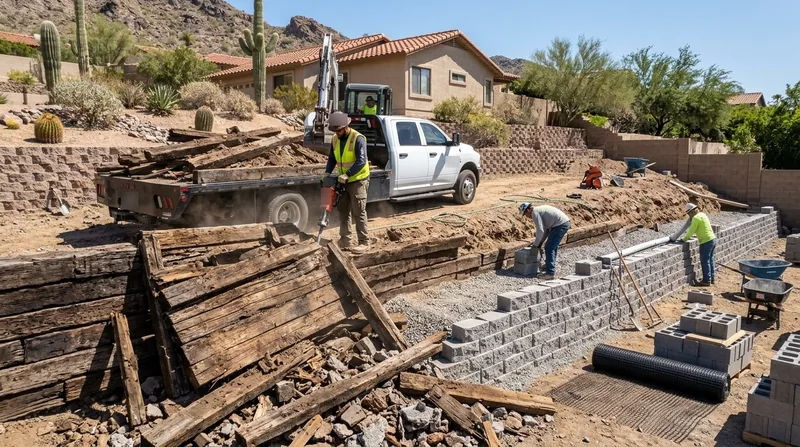




Retaining Wall Replacement in Phoenix is a critical service for homeowners dealing with failed walls that no longer hold back soil, water, or the desert landscape. Phoenix's unique terrain, sprawling from flat valley floor to rocky foothills, means retaining walls are everywhere: holding cut slopes in Ahwatukee, terracing desert landscaping in Moon Valley, stabilizing driveways in 1950s Arcadia lots, and supporting structures in older neighborhoods like Encanto-Palmcroft. The desert's harsh conditions, monsoon flooding, caliche hardpan that traps water, and decades of thermal cycling take a toll on aging walls. Whether your wall is a crumbling railroad tie structure from the 1970s, a leaning concrete block face, or a poured-concrete wall that's cracked and settling, we remove the failed wall completely, haul it away, and rebuild with modern materials and proper drainage suited to Phoenix's unforgiving soil and climate. This page covers why replacement matters, how we approach the work, what materials work best, and what you should expect to invest.
Why Retaining Wall Replacement Matters in Phoenix's Desert Climate
Phoenix walls fail faster than most homeowners expect. The combination of caliche hardpan that stops water drainage, pockets of expansive clay that swell and shrink, intense summer heat, and periodic monsoon cloudbursts creates a perfect storm for wall failure. Railroad tie and timber walls, common in 1970s and 1980s construction, succumb to termite damage and rot. Concrete block and poured-concrete walls crack, lean, or settle as the soil beneath them shifts. When a wall fails, it's not just unsightly, it's a safety and liability issue, and it can trigger cascading erosion, flooding, or foundation problems for the structure it was meant to protect.
- We excavate and remove the failed wall, including all debris and compromised soil at the base.
- We install new drainage systems designed to handle Phoenix's monsoon and flood-irrigation runoff.
- We rebuild with engineered materials (concrete, segmental block, or stone) matched to your site and soil conditions.
- We ensure the new wall meets current building codes and, where required, obtain permits and engineer sign-off.
- We grade and compact the backfill to prevent settling and future water intrusion.
A failed wall left unaddressed will only worsen, eventually undermining adjacent structures or creating a safety hazard on your property.
Key info: Phoenix's City of Phoenix Building and Safety Department, along with individual jurisdictions in Scottsdale, Tempe, Mesa, and Chandler, typically require permits for walls over 4 feet or walls supporting a structure. We handle all permitting and coordinate with the local building department so your replacement is legal and inspected. Check with your city or HOA before starting any work. For current permit thresholds and requirements, visit your city's building department website or call (480) 494-4792 to discuss your specific situation.
For more on wall repairs and stabilization, see our retaining wall repair service if you are exploring whether repair or full replacement is the right choice for your wall.
How We Replace a Retaining Wall in Phoenix: A Step-by-Step Process
Retaining wall replacement in Phoenix is a methodical process that begins with understanding your soil, drainage, and the original wall's failure mode. We start with a site inspection to assess the wall's condition, the slope and soil behind it, groundwater flow, and any nearby structures or utilities. We then plan the removal, new drainage strategy, and material choice based on the site's unique demands. The desert's hard caliche layer, for example, may require specialized excavation. Monsoon flood patterns and wash proximity factor into drainage design. We work systematically to avoid damaging adjacent landscaping, utilities, or neighboring properties.
- We mark utilities and obtain any required locates before we break ground.
- We demolish the old wall using heavy equipment and remove all concrete, block, timber, or stone debris.
- We excavate and prepare the base, removing any loose or compromised soil and breaking through caliche if necessary.
- We install a new footing and drainage layer (gravel, perforated pipe, or both) to shed water away from the wall.
- We build the new wall using your chosen material, properly backfilled and compacted in lifts.
- We finish grading and landscaping to match your property and ensure proper surface drainage.
From demolition to final grade, most residential wall replacements take 3 to 7 days depending on wall length, height, and access.
Example: A 40-foot-long, 5-foot-tall railroad tie wall in Tempe failed due to termite damage and settlement. We removed the rotted timber, excavated 2 feet below grade, found caliche and broke through it, installed a perforated drain line with gravel, and rebuilt with engineered segmental block. The new wall was finished in 5 days, permitting took 2 weeks, and the homeowner now has a 50-year-rated structure with no termite risk.
Learn more about specialized drainage solutions on our retaining wall drainage service page.
Retaining Wall Replacement Materials and Methods for Phoenix Soil
Phoenix's diverse neighborhoods and terrain call for different wall materials. A 1950s slump-block ranch in Arcadia may benefit from concrete block replacement. A hillside home in Ahwatukee might need engineered segmental block or poured concrete. A property with natural stone outcrops might use boulder or native granite. Each material has trade-offs in cost, durability, appearance, and suitability to the specific soil and drainage conditions at your site. We assess your wall's original material, the reason it failed, and the site's drainage and soil characteristics to recommend the best replacement approach.
| Material / Method | Description | Best For |
|---|---|---|
| Segmental Retaining Wall (SRW) Block | Interlocking engineered blocks, stacked dry or with adhesive, no mortar. High structural rating, excellent drainage. | Most residential walls, hillsides, modern subdivisions, areas needing fast installation and minimal settling. |
| Poured Concrete | Monolithic cast-in-place wall, often with a stucco or exposed finish. Very strong, long-lived in desert climate, requires proper drainage. | Tall walls, high-load applications, areas where a seamless appearance is desired, and properties with existing poured-concrete walls. |
| Concrete Masonry Unit (CMU) Block | Standard concrete block, mortared, often stucco-faced. Common in older Phoenix homes, affordable, requires good drainage to avoid efflorescence and failure. | Replacement of existing block walls, cost-conscious projects, walls under 6 feet where engineering allows solid masonry. |
| Boulder and Natural Stone | Native granite, granite boulders, or stacked stone, often used dry or with minimal mortar. Blends with desert landscape, excellent drainage. | Foothills and hillside properties, aesthetic priority, natural desert appearance, low-to-medium height walls where stone is locally available. |
| Timber (Pressure-Treated or Composite) | Treated lumber or composite beams, typically 6x6 or 6x8, stacked and braced. Lower cost, natural appearance, but shorter lifespan in Phoenix heat and moisture cycling. | Low-to-medium walls, landscaping borders, temporary or semi-permanent structures, budget-conscious installations where durability is secondary. |
Each material carries different labor, material, and long-term maintenance costs. Segmental block and poured concrete are the most popular for permanent replacement in Phoenix because they handle the desert's soil movement and moisture cycling without significant degradation.
Retaining Wall Replacement Cost in Phoenix: What to Expect
Retaining wall replacement cost in Phoenix typically starts at $35 per square foot for straightforward segmental block walls on accessible, well-prepared sites. A 40-foot-long, 5-foot-tall wall (200 square feet) might run $7,000 to $10,000 or more, depending on material, site access, soil conditions, and whether caliche removal or special drainage is needed. Poured concrete walls run higher, from $45 to $60 per square foot or more. Boulder and stone walls vary widely based on material availability and labor intensity. Small timber walls might start lower but often require replacement sooner. The cost factors that move a project up include: wall height and length, difficult soil (caliche, clay, rock), poor site access, proximity to structures or utilities, required permits and engineering, and local labor rates.
Always get 2 to 3 estimates before committing. Each contractor will assess your site differently, and material choices can swing the total significantly. We provide a free, no-obligation estimate within 24 hours. Call (480) 494-4792 or visit our pricing page for more detail on material costs and what drives variation.
Permit costs, if required, are typically $200 to $500 depending on your city. Engineered drawings (required for tall or tiered walls) can add $500 to $1,500. These are separate from the wall itself but are part of the total project investment.
Retaining Wall Replacement Near Me: What Phoenix Homeowners Should Know When Hiring a Contractor
Choosing a contractor for retaining wall replacement is a significant decision. You want someone who understands Phoenix's soil, drainage, and building codes, has the equipment to handle demolition and heavy excavation, and can navigate the permitting process. Not all contractors are equal, and a cheap bid often reflects corners cut on drainage, compaction, or material quality. Ask the right questions before you hire, and verify that your contractor is licensed, insured, and experienced with walls in your specific neighborhood or terrain type.
- Confirm the contractor holds a current Arizona Contractor License and carries general liability and workers compensation insurance.
- Ask for references from wall replacements completed in your city or neighborhood within the last 3 years.
- Verify that the contractor understands local permit requirements and will handle permitting and inspections as part of the job.
- Discuss drainage strategy explicitly, especially if your wall is near a wash, in a flood zone, or has a history of water issues.
- Get the estimate in writing, specifying material, wall dimensions, footing depth, drainage method, and timeline.
- Check whether your HOA (if applicable) requires approval or has restrictions on wall materials or appearance.
A contractor who takes time to explain the work, answers your questions clearly, and provides a detailed written estimate is more likely to deliver a quality result.
Ready to move forward? Contact us for a free estimate or call (480) 494-4792. We serve Phoenix, Scottsdale, Tempe, Mesa, Chandler, Gilbert, and surrounding areas.
Retaining Wall Replacement in Phoenix: Pricing Guide
| Service | Price | Details |
|---|---|---|
| Segmental Block Wall Replacement | Starting at $35/sq ft | Material, labor, footing, and drainage included; cost increases with wall height, caliche removal, or difficult access |
| Poured Concrete Wall Replacement | Starting at $45/sq ft | Formwork, concrete, finishing, and drainage included; taller walls or engineered designs may increase the per-square-foot rate |
| CMU Block or Timber Wall Replacement | Starting at $30/sq ft | Lower material cost than segmental or concrete; durability and lifespan vary, and timber walls may require more frequent maintenance or earlier replacement |
| Boulder or Natural Stone Wall Replacement | On estimate | Price depends on stone availability, quarry distance, and labor-intensive stacking; foothills and hillside sites often require site-specific assessment |
| Permit, Engineering, and Inspections | $200 to $1,500 | Permit cost varies by city and wall height; engineered drawings required for tall or tiered walls and are invoiced separately from the wall build |
| Free Estimate | No obligation | Response within 24 hours at (480) 494-4792; we assess your site, soil, drainage, and material options before quoting a price |
Indicative pricing, the exact cost depends on square footage, finish, and site access. Free personalized estimate within 24h at (480) 494-4792.


