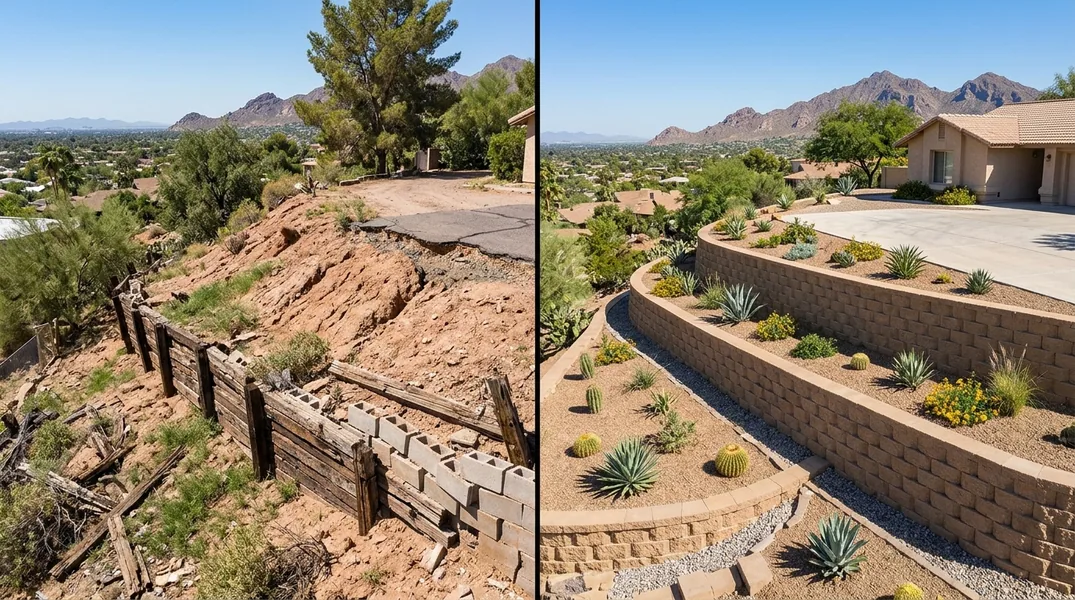
The Desert Climate Challenge: Why Phoenix Retaining Walls Fail
Phoenix presents a unique set of challenges for retaining wall longevity. The intense desert heat, extreme temperature swings, and infrequent but heavy rainfall create conditions that accelerate structural deterioration. Unlike milder climates, homeowners in the Valley of the Sun face a perfect storm of environmental stressors that can compromise even well-built walls within years if proper maintenance and installation practices aren't followed.
The primary culprit is the freeze-thaw cycle, which occurs even in our relatively warm climate. When moisture enters the soil behind your retaining wall during rare winter rains or irrigation, it expands as temperatures drop at night. This expansion puts tremendous pressure on the wall structure. Over time, repeated cycles of expansion and contraction weaken mortar joints, crack concrete, and shift the wall's foundation. Combined with our intense summer heat that can exceed 120 degrees Fahrenheit, materials expand and contract at different rates, creating stress points that eventually lead to failure.
Spotting a Failing Retaining Wall: Early Warning Signs
Early detection is your best defense against catastrophic retaining wall failure. Homeowners should regularly inspect their walls for subtle signs of distress that indicate professional intervention is needed. A Retaining Wall Repair expert can often save a wall in its early stages of failure, but only if the problem is caught before structural integrity is completely compromised. The most common warning signs include visible cracks, particularly horizontal ones running along the face of the wall or diagonal cracks spreading from corners.
Horizontal cracks are especially concerning because they indicate that hydrostatic pressure is building behind the wall. This pressure develops when water accumulates in the soil and has nowhere to drain, pushing against the wall with tremendous force. Another critical warning sign is efflorescence, the white, chalky substance that appears on concrete or masonry walls. This indicates water is moving through the wall and depositing mineral salts on the surface. If you notice any of these signs, contact Phoenix Retaining Wall at (480) 494-4792 for a professional assessment before the situation worsens.
Understanding Bowing and Leaning Retaining Walls
A bowing retaining wall is one of the most visually obvious signs of structural failure, yet many homeowners delay action hoping the problem will resolve itself. Bowing occurs when the wall bulges outward, typically in the middle section, indicating that the soil pressure behind the wall exceeds the wall's capacity to resist it. This is a critical structural issue that demands immediate attention. A leaning retaining wall, by contrast, tilts away from the retained soil at an angle, suggesting foundation settlement, inadequate drainage, or poor initial construction. Both conditions indicate that Retaining Wall Replacement may be necessary rather than simple repair.
The causes of bowing and leaning are often interconnected. Poor drainage is the leading culprit in Phoenix retaining wall failures. When drainage systems fail or were never installed properly, water saturates the soil behind the wall, creating hydrostatic pressure that the wall structure cannot withstand. Additionally, inadequate compaction during initial installation, use of substandard materials, or insufficient wall thickness can contribute to these problems. In some cases, the wall may have been properly constructed but subjected to added soil load from landscaping, irrigation systems, or nearby construction that wasn't anticipated in the original design.
Drainage Failures: The Silent Killer of Retaining Walls
Proper drainage is absolutely essential to retaining wall longevity, yet it's often overlooked or poorly executed during Retaining Wall Installation. Water that accumulates behind a retaining wall creates hydrostatic pressure that increases exponentially with the height of the wall. Even in the dry Phoenix climate, irrigation from landscaping, occasional heavy rains, and subsurface water can saturate the soil. Without adequate drainage, this water has nowhere to go except to push harder against your wall.
A properly designed retaining wall should include a perforated drainage pipe at the base, a gravel drainage layer behind the wall, and weep holes through the wall face to allow water to escape. If your wall lacks these features or if they've become clogged over time, water will accumulate and eventually cause failure. Many homeowners don't realize their drainage system isn't functioning until visible damage appears. Regular inspection of weep holes, ensuring they're clear and water is flowing freely, can prevent many costly problems. If you suspect your wall's drainage system is failing, a free estimate from Phoenix Retaining Wall can identify the issue and recommend solutions.
Material Selection and Construction Quality Matter
Concrete Retaining Walls are popular in our region, but not all concrete is created equal. The quality of materials, the water-to-cement ratio, and the curing process all significantly impact how well a wall will withstand Phoenix's harsh climate. Concrete that's exposed to intense UV radiation and extreme temperature swings can develop surface spalling, where the outer layer flakes away, eventually exposing interior reinforcement to rust and further deterioration. Poor quality concrete or concrete mixed improperly is particularly vulnerable to this type of damage.
The reinforcement inside the wall is equally important. Steel rebar or wire mesh must be properly positioned and spaced according to engineering specifications. Corrosion of reinforcement is a common failure mode in retaining walls, especially in areas where salt or de-icing chemicals are present, though this is less common in Phoenix than in northern states. However, improper concrete cover over the reinforcement or concrete that's too porous allows moisture penetration that accelerates rust. When choosing between Retaining Wall Repair and replacement, the extent of reinforcement corrosion is a key factor. If the rebar is significantly corroded, repair may only be a temporary solution, and full replacement may be the better long-term investment.
When to Repair vs. When to Replace Your Retaining Wall
Not every failing retaining wall requires complete replacement. Minor cracks, small areas of spalling, and drainage issues can often be addressed through targeted repair work. However, determining whether repair is sufficient or replacement is necessary requires professional evaluation. Factors to consider include the wall's age, the extent of visible damage, whether the wall is still moving or has stabilized, and the cost of repair compared to replacement. A wall that's actively failing, with multiple structural issues and ongoing movement, is typically a candidate for replacement rather than repair.
The pricing for repair versus replacement varies significantly based on the wall's size, material, and the extent of work needed. While repair is typically less expensive upfront, a wall that requires extensive repair work may fail again within a few years, leading to additional costs. Replacement, though more expensive initially, provides a long-term solution with a warranty and the peace of mind that comes with a properly engineered, newly constructed wall. Phoenix Retaining Wall can evaluate your specific situation and recommend the most cost-effective solution. Call (480) 494-4792 today to schedule your inspection and receive professional guidance on the best path forward for your property.
Looking for a professional retaining wall contractor in Phoenix? Phoenix Retaining Wall responds fast for all your retaining wall needs.
Get a Free QuoteOur services: Retaining Wall Installation · Retaining Wall Repair · Retaining Wall Replacement